
What is Myopia?
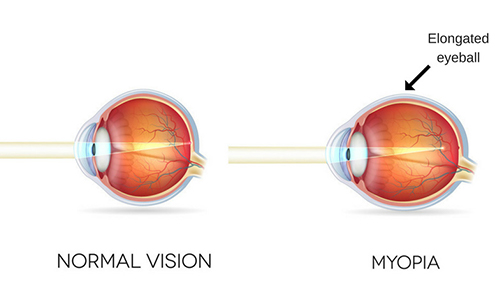
Myopia is the clinical term for nearsightedness. Nearsighted eyes see nearby objects clearly, while objects far away are blurry without glasses. Just like feet get bigger and children get taller, the nearsighted eye tends to get longer over time. This means nearsighted children often need to get stronger glasses every year as their eyes continue to grow.
What is the Myopia Management Clinic?
The Myopia Management Clinic is an evidence-based treatment program for myopia located at Drs. McIntyre, Garza, Avila & Jurica. Our doctors seek to slow the progression of myopia in children by using the latest research-based treatments for controlling myopia.
What causes Myopia?
Researchers are not sure what exactly causes myopia, but it is understood that genetics play an important role, as does lifestyle choices.
How can I correct Myopia?
Myopia causes far away objects to look blurry, but the blurry vision can be corrected with glasses, contact lenses or refractive surgery. There may also be ways to control the growth of myopia.
Why try to manage Myopia growth?
Myopia treatments have been shown to reduce a person’s myopia by up to 60 percent, which could reduce the need for wearing glasses or contact lenses. Myopia has also been associated with common vision-threatening conditions like cataracts, primary open angle glaucoma and retinal detachments. The risk of developing these conditions depends on the severity of the myopia; therefore, reducing a person’s myopia could also decrease his or her chances of developing one of these vision-threatening diseases.
What are some of the treatments for managing Myopia?
Corneal Reshaping Contact Lenses
Corneal reshaping contact lenses are worn during sleep and are removed in the morning. They temporarily change the shape of the cornea so that a person can see clearly all day long without glasses or contact lenses. They are also thought to slow myopia development because they bend light that enters the eye in a beneficial way. Corneal reshaping contact lenses have been shown to reduce myopia progression on average by about 50 percent.
Duel Focus Soft Contact Lenses
Duel focus contact lenses also are thought to slow myopia by bending light that enters the eye in a beneficial way. These lenses have been shown to reduce myopia progression on average by about 50 percent.
Atropine
Atropine is an eye drop that has been shown to slow myopia progression by about 60 percent.
How long do I need to be treated?
The scientific community does not yet fully understand how long people should be treated with myopia prevention methods, but the general consensus is that people be treated until they are at least in their mid-teens or longer.
Are Myopia treatments safe?
Contact Lenses
There is a small risk involved when any contact lens is worn. Side effects are pain, redness, tearing, irritation, discharge, or abrasion of the eye. These are usually temporary conditions if the contact lenses are removed promptly. In very rare instances, infections of the eye may occur.
0.01% Atropine
Low dose atropine is considered to be safe for children.
What are my Myopia treatment options?
There are three ways to potentially slow the progression of myopia: corneal reshaping and soft bifocal contact lenses and/or atropine eye drops. Each treatment has its own risks and benefits. Consult with one of our providers for more information.

Myopia Management Options:
Multifocal Soft Contact Lenses/Orthokeratology
The scientific community does not yet fully understand how long people should be treated with myopia prevention methods, but the general consensus is that people be treated until they are at least in their mid-teens or longer.
With Treatment - 50% Reduction
Percentage reduction in progression of myopia compared to standard correction e.g. single vision spectacles.
If treated with Multifocal soft contact lenses/Orthokeratology that provides 50% control, then the level of myopia at 17 may be:
-2.63D
Without Treatment
If myopia control treatment is not commenced immediately, the final level of your child’s myopia at 17 may be:
-4.19D
Odds/ratios of increased risk of ocular disease with increasing levels of Myopia
Risk factors for development of progression of myopia
Family History
One myopic parent – three times greater risk of myopia development.
Two myopic parents – six times greater risk of myopia development.
Two myopic parents – greater risk of progression to high myopia.
Time spent outdoors
Less than 1.6 hours per day increases risk two- to three- fold.
Time spent on near work
More than 3 hours per day (excepting school time) – only when co-factored with low time spent outdoors.
Age of onset
Younger (6 to 7 years) versus older (11 years) onset gives a 6.6 times risk of progression to high myopia.
Current refraction
Less than +0.50D at age 6 to 7 years is a risk for myopia development. The fastest refractive change occurs in the year prior to myopia onset.
Ethnicity
Asian ethnicity may be linked to faster progression. The risk factors of current refraction, time spent outdoors and family history risk of high myopia are independent of ethnicity.